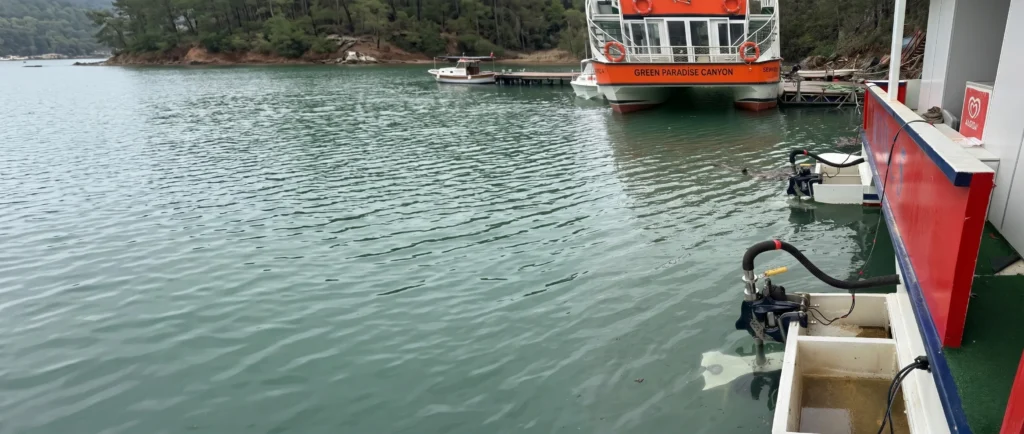
A commercial solar electric catamaran conversion has replaced the last petrol engines on the excursion fleet at Oymapınar Dam, in the Manavgat district of Antalya. The operator switched to 100% electric New Stream propulsion developed by Nama Mobility, cutting exhaust emissions and fuel-spill risk on an enclosed freshwater reservoir. It is one of the few electric boat conversions in the region running commercially, in season, on paying passengers — not as a pilot.
Three years and four countries before the electric boat conversion worked
Getting to zero emissions took the operator far longer than expected. Tourism companies at Oymapınar Dam spent close to three years trying to convert their petrol catamarans to electric drive. Motor brands from Austria, Germany, China and Turkey were tested over that period. None of them — imported or domestic — could move a hull of this size efficiently enough to hold the schedule.
The failed trials were not just disappointing, they were expensive: half-finished integrations cost the businesses both money and operating days. What finally held up were the systems already proven on the water — the same New Stream installations that had run three full seasons at Manavgat Dam without a season-ending failure. That service record, more than any spec sheet, decided it.
48 kWh of battery, 14.9 kWp of solar, zero fuel
The system was specified from the outset as a solar installation rather than a drop-in engine swap. Twenty-four marine solar panels of 620 W each — 14.9 kWp in total — feed the drive batteries through MPPT charge controllers: twelve to port, twelve to starboard, so both hulls of the catamaran draw down and recharge in balance.
- Vessel: catamaran, 16 m length × 6 m beam, up to 150 passengers
- Drive: 2 × NS-OUT-16 electric outboard motors, CE marked, with power trim and tilt
- Power at cruise: 6 kW per motor at 6 knots — 12 kW total
- Solar array: 24 × 620 W = 14.9 kWp, split 12 to port and 12 to starboard
- Charge control: MPPT charge controllers per side
- Storage: 2 × 24 kWh NAMA Power LiFePO4 battery packs — 48 kWh total, one per hull
- Duty cycle: 3 tours a day, 8 nautical miles each — 24 nm, about 4.5 hours under way
- Overcast reserve: 4 hours at 6 knots on battery alone, with no solar input
- Shore charging: 220 V available as backup, not needed on the daily route
- Fuel: none — no petrol, no diesel, no generator

That last line is what makes the installation unusual. The catamarans complete all three daily tours on solar energy alone, without connecting to a charging point and without fossil-fuel backup. The 220 V connection exists for the exception, not the rule: even with no sun at all, a full pack covers four hours of cruising — longer than a single tour.
What one boat used to burn: 6.5 tonnes of petrol a month
Before the conversion, each catamaran burned 30 to 40 litres of petrol per hour, per engine. Across three tours a day that came to roughly 6.5 tonnes of petrol a month for a single boat — about €10,000 a month in fuel alone at local pump prices. Add servicing, oil changes, filters and the winterisation that combustion outboards demand, and the figure the operator no longer pays comes to roughly €12,000 a month per vessel.
Those are the numbers that decide a retrofit. Sunlight over the reservoir is free and the panels are already paid for; the recurring cost that used to scale with every extra tour has simply been removed from the books. The environmental case and the commercial case point the same way here, which is rare enough to be worth stating plainly.
Green Paradise Canyon commits to a zero-emission fleet
Mehmet Sevinç, owner of Green Paradise Canyon, one of the larger tourism operators in the Green Canyon region, signed the agreement that moves the company off fossil-fuelled boats altogether. Sevinç frames the decision less as a marketing position than as a condition of operating on an enclosed freshwater reservoir at all.
“Thanks to this system developed with Nama Mobility, we run all the daily activities of our facility on nothing but clean energy generated and stored from the sun.” — Mehmet Sevinç
Why inland and protected waters go electric first
Enclosed inland waters are where the rules tighten earliest. Sometimes the reason is public health: a fuel leak in a drinking-water reservoir is a health incident, not merely an environmental one. Scotland is the clearest precedent of that kind: Loch Katrine has supplied Glasgow’s drinking water since 1859, and the passenger steamer that works the loch was kept on solid fuel for a century and has run on biofuel since 2007 — specifically to meet the requirement that the city’s water supply is not polluted.
Turkey is moving the same way, and not only where drinking water is at stake. The Köyceğiz–Dalyan Specially Protected Area is a delta and channel system rather than a reservoir, and there the driver is conservation: a programme run by the Muğla Governorship and associated bodies aims to convert to electric drive, within two years, the 257 passenger-licensed boats among the 492 commercial vessels working the channels — cutting water and air pollution and, above all, the noise that disturbs the area’s birdlife and its nesting loggerhead turtles. Under tightening sustainability standards, operators who convert ahead of the rules keep their licences and their routes; operators who wait convert later, under a deadline, at a worse price.
What a solar electric catamaran conversion means for other operators
Oymapınar is a useful reference case precisely because it is ordinary commercial work: tour catamarans, a fixed daily schedule, 150-passenger capacity, and a season that does not pause for engineering. Self-sufficient solar catamarans are no longer a demonstration project — they are a working model for sustainable marine tourism anywhere a lake, reservoir or protected bay closes to combustion engines.
If you operate excursion boats on a lake, reservoir or protected coastline and want to know what a solar electric catamaran conversion would take on your hull, talk to the Nawis Marine team — or browse the full New Stream electric outboard range.